
 Posts
Posts


What does a fuzzy little bunny have to do with a
crucified King of the Jews?

Many years ago that very question led me to ask questions about religious celebrations, the connectivity of religions and the just plain weirdness of religions. What follows are some of the answers I found along the bunny trail.
It all begins with Spring.
Why is this season different from all others?
Because between mid-March and late April we get the Vernal Equinox and three major religious holidays: NoRuz, Easter and Passover.
The Vernal Equinox is when the Sun can be observed to be directly above the equator. The word equinox is derived from the Latin word aequinoctium (equal night). Basically, the day is equally divided between light and dark. At this time of year, the Southern Hemisphere is entering autumn while cultures in the Northern Hemisphere celebrate their spring festivals.
NORUZ
On March 20th in Iran and parts of India the festival of Noruz was celebrated. Noruz, meaning: New Day, is sometimes spelled NowRuz. So now you know that the English word “New” comes from the Indo-European word “Now.” Who knew? Other Iranian/Farsi words you would recognize in English are Shekar (Sugar),Sharbat (sherbet) Doktar (daughter) Madar (Mother). And if you play chess you use a Persian expression when you’ve checked the king. You yell SHAH MAT ! (the King is dead) Except, you pronounce it “checkmate!”
Noruz, sometimes referred to as Persian New Year, is the spring festival of Zoroastrianism.
Zoroastrianism is one of the oldest religions still in existence, founded by Zarathustra (Zoroaster in Greek) somewhere around 1500 BC, 500 years or so before Moses. Reportedly the world's first monotheistic religion, its theology had a profound impact on Judaism, Christianity and Islam. Zoroastrianism introduced beliefs concerning the soul, God, Satan, heaven, hell, a savior born of a virgin who will raise the dead on judgment day and all sorts of familiar religious concepts.
Zoroastrians believe in a single god called Ahura Mazda.
They also believe there exists a pissed off potentate, an evil spirit of violence and death, Angra Mainyu, who opposes Ahura Mazda. Angra Mainyu is where we get the English word "Anger". To counter Angra Mainyu there is Spenta Mainyu –the Holy Spirit. There was also a demi-god named Mithra who would mediate between Ahura Mazda and the earth.
One part of Noruz is the feast called Chahar Shanbeh Soori, the Four Saturday Feast. It’s held four days after the last Wednesday of the year. The concept is the spirits of your ancestors pay a house call that day. So, children, both boys, and girls dress up in chadors (similar to the burka in Afghanistan.) These little ghosts knock on doors asking for treats. Sounds like “trick or treating” to me. By the light of a bonfire, they run through the streets with their New Year’s noisemakers, banging on pots and pans with spoons called Gashog-Zani to chase away the old year. If you’re a regular reader of my Holiday memos you’ll notice, I’m sure, the amazing similarity to the Celtic New Year --Samhain from which the modern Halloween celebration evolved. An even odder Irish/Iran connection is that the Persians have a trefoil plant with magical powers whose Farsi name is a Shabdar, when translated into Arabic it becomes Shamrakh.—sounds a bit like Shamrock, doesn’t it? Well, Shah and begorra! Actually, it’s not coincidental at all.. The Celtic language along with most European languages is called Indo-European. The prevailing theory being these languages spread from India to Iran and then on to Europe. You might remember that the Nazi’s claimed their ancestors were the Aryans. The Aryans were the peoples who moved west from India into Iran and then Europe. The name “Iran” means: Land of the Aryans.
One Noruz belief is that whatever a person does at this time will affect the rest of the year. Sounds just like Chinese New Year doesn’t it? Women also make a New Year’s wish then go out on the street and eavesdrop. The first conversation they hear will be an answer to their wish. Like almost all cultures there is a Spring Cleaning ritual called Khaneh Tekani, which literally means, “Shaking the House.” Cleaning it the way you would shake out a rug.

Hadji Firuz.
One New Year’s noisemaker unique to Iran is Hadji Firuz. People dress up as Hadji in a red costume and blackface and dance through the streets beating tambourines to herald the coming New Year. It has something to do with the fact that slaves were once the entertainers in the Persian Court.
There’s a lot more symbolism and history in the festival than I’m able to get into here, check out this site if you want to know more: www.persianmirror.com/celebrations/NoRuz/NoRuz.cfm
But here’s the stuff germane to our little memo: a major part of the NoRuz New Year ritual is the family gathering around a special table for a feast called Haft Seen.

It consists of seven symbolic items that begin with the letter 'Seen,' the S in Arabic alphabet. There is Sombol (hyacinth) and Sekkeh (coins) and Sabzeh (sprouted greens) and Seer (garlic) and Senjed (a fruit only found in Iran), a mysterious gooey chocolaty brown stuff called Samanoo. And finally --Serkeh (vinegar). Originally it included wine (Sherab,) but that was replaced by vinegar when Iran became Muslim and alcohol was banned.
Other items found on the table are goldfish –symbolic of life, mirrors -- a symbol of self-reflection and a fertility symbol --eggs. The eggs are colored in bright reds, greens and yellows. Which brings us back to Easter & Passover
PASSOVER
It is, of course, no coincidence that Easter and Passover are usually celebrated around the same time. In Judaism the celebration of Passover commemorates the Hebrews liberation from slavery in Egypt and the "passing over" of the forces of destruction when the Lord "smote the land of Egypt" Smote, now there's a word you don't hear too often. The modern equivalent translation of "smote" is "to open up a can of Whoop-ass."
There's some conjecture that Passover is actually the melding of two separate Jewish celebrations, one involving a lamb from nomadic times, the other centered on grain from an agricultural celebration.
Passover today is a chance for Jewish families to gather at a communal dinner, a Seder (The Order) and recount the story of the Exodus while following a prescribed ritual.
For you goyim here's an explanation of the Exodus in 150 words or less:
3000 years ago.
Jewish captivity in Egypt.
Moses: "Let My People go"
Pharaoh: "Fuggedhaboudit".
G-d: "Special Delivery for Pharaoh - 7 plagues. We got your frogs, your vermin, your flies, mad cow disease, locusts, boils, hail, oh yeah and slaying of your first born (always a biggie in biblical times.)
The Jews mark their doors with lamb's blood so G-d knows not to come a knockin’. He passes over their homes.
Finally Pharaoh says "You wanna go, get outta here."
Jews have to leave in a hurry; don't have time to bake focaccia to snack on in their Ford Explorers as they head off-road across the desert towards Israel. They make unleavened bread - matzo. Pharaoh's Army chases them. They reach the Sea of Reeds (later mistranslated into The Red Sea); Moses whips out his Divine E-Z pass. Jews get across. Pharaoh's Army goes for a dip.
Pretty much covers it.
Charlton Heston fits in there somewhere but it gets way too confusing.

The Seder is the most important event of the 8 days of Passover. It takes place the first two nights. Similar to the Christian Mardi Gras /Pancake Day all non-kosher foods containing yeast are consumed or disposed of before the holiday begins, otherwise they're not as the saying goes "Kosher for Passover."
Glatt –- wat’s dat?
You may see the term “Glatt Kosher” on certain foods. Most folks think it implies this stuff is Extra-Strength Kosher, the best of the blessed. In fact, it just sorta means that the animal was a non-smoker. Huh? Glatt is Yiddish for smooth, it means that the lungs of the animal were smooth, without any adhesions, scars or punctures. Basically this law kept folks from eating diseased animals or leftover roadkill. There is no such thing as Glatt kosher chicken, fish, or dairy, but that doesn’t mean you won’t see the G word plastered all over them. Which when you think about doesn’t seem quite Kosher.
Like the Haft Seen --The Seder plate contains 5 foods which all have symbolic meaning:

Haroseth, a mixture of chopped walnuts, wine, cinnamon and apples that represents the mortar the Jewish slaves used to assemble the Pharaoh's bricks.
Parsley to symbolize spring, dipped in salt to remind us of the salty tears of the slaves.
Egg, again to symbolize spring.
Lamb bone, okay we got that.
Bitter herbs to symbolize the bitter life the slaves led.
Jewish children ask the famous 4 questions. (One of them is not: When am I getting a Sony PlayStation? Questions like: Why do we lean on a pillow tonight?
Answer: To remind us that once we were slaves and uncomfortable but now we are free. The answers explain the symbolism of the objects and infuse a sense of history/culture.
At one point in the Seder the front door is opened to allow the Prophet Elijah in. After the meal children search for a piece of Matzo wrapped in cloth called the Afikomen (meaning: after dinner). The one who finds the Afikomen gets a prize.
EASTER
Which brings us up to Jesus. He was Jewish, presumably as a child he searched for the Afikomen. He was crucified during Passover. The Last Supper was a Seder. As mentioned, three foods served at this religious meal are shank bone, symbolic of the Paschal lamb, an egg and matzo bread. The symbolic use of the lamb and the egg both survive in the Christian Easter. Christ being considered the sacrificial lamb for man's sins and, of course, the Easter egg. Passover's unleavened matzo bread survives in the Christian Communion wafer. Some Christian groups contend Christ's body wrapped in linen in his tomb was the afikomen for mankind. The gift/prize was revealed upon his resurrection.
Early Christians (whom I guess could be considered the very first Jews For Jesus) did not celebrate Easter. They continued to observe the Jewish religious holy days, though in a new spirit, thus Passover had a new concept added to it of Christ as the true Paschal Lamb. Paschal is from the Hebrew " pesach " (Passover) from the verb form "he passed over."
As the Christian faith evolved Easter came into its own.
But wait, we're all the way up to 400 AD or so.
Let's back up a bit.
Ancient Antecedents
By now you know there are some pretty well established pagan customs that we unknowingly follow to this day. So let's go back to some of the pagan origins of Christianity's most solemn holiday. Read on and discover the hidden origins of Sunrise Services, Lenten fasting, Easter Eggs, the Easter Bunny and even the word "Easter."
Easter in the Christian faith is a festival of resurrection, a celebration of Christ, the Son of God, rising from the dead. On another symbolic level it is also a celebration of nature returning from the dead, a welcome home party for the pagan Earth Mother or if you prefer "Mother Nature" who arrives in the form of spring.
It probably comes as no surprise to you that back there in BC, Before Christ, the Greeks, Romans, and Egyptians had festivals of resurrection in spring.
Babylonian Resurrection legends
 |
Ishtar/Astarte |
Astarte was the mother goddess of the ancient Assyrians, she was
also known as Ishtar. Astarte was hatched from a huge egg that fell into the Euphrates. Astarte's husband Tammuz croaked. Astarte fasted for 40 days and went looking for him in the underworld and by her grief she was able to bring him back to life. In honor of Astarte, Babylonians considered eggs sacred and they were not eaten for the period of her mourning (which interestingly corresponds with the concept of giving something up for the 40 days of Lent.)
Egyptian Resurrection Mythology
 |
Osiris |
The Egyptians influenced the Hebrews (look no further than Moses, which is an Egyptian name) and the Hebrews influenced the early Christians (Look no further than the Pope who wears a yarmulke.) So it's interesting to note an Egyptian resurrection legend that predates Christ. The Egyptian gods Isis and Osiris were not only sister and brother; they were husband and wife. Osiris was the Son of God. His daddy was Ra - the sun god. Did that make him the son of sun? Osiris is many times depicted with green skin --since he was the god of vegetation, which is why spring is an important time for him. Osiris is whacked by his brother, the god Seth. Seth chops us his body. Isis tries to put him back together. She finds everything but a fairly important component ---his penis. After one day and two nights she is able to bring him back to life but only temporarily. He rises from the dead at sunrise; after all he is the son of sun. It happens to be the day of the Vernal Equinox, the first day of spring. They make love (G-d knows how!) then Osiris returns to his father in the heavens. Osiris will eventually leave his father and become the god of the underworld. Hey if you lost your manly member you wouldn't be in too sweet of a mood either.
40 weeks after they do the big nasty Isis gives birth to a son, Horus. The date of his birth -- Dec 25th. You’re familiar with the date I’m sure and already know that Christians chose this date to venerate a son of God who returned to the right hand of his father ---in the hopes it would supersede pagan celebrations to Horus and another powerful god Mithra.
Mithra/Mithras
A fascinating god. He was Persian and as their empire spread he was introduced to new cultures. In India he became a Hindu God - Mitra. Eventually, he would be worshipped throughout the Roman Empire. The fascinating thing about Mithra is the uncanny similarity to Jesus. He was worshipped 800 years before Christ but here’s Mithra’s bio: He was born of a Virgin, was part of a divine trinity, had twelve followers, who were baptized into the faith and ate bread and drank wine to symbolize the body and blood of god. They looked forward to a final day of judgment when true believers would rise from the dead and do battle until the forces of light triumphed over darkness. Mithras died and was resurrected. This compassionate god was known as the light of the world and was born on December 25. Holy Happenstance Batman!
It is also interesting to consider that Easter Sunrise Services have become more and more popular. On some subliminal level, they harken back to sun worship, which was one of the earliest religions. In ancient Babylon, the sun was personified as Tammuz, the returning lover of Ishtar. It was at dawn that the Egyptian Osiris rose to join the sun god in the sky. Even today, Druids hold sunrise services on the summer solstice.

Greek Resurrection Mythology
In Greek mythology Demeter was the Earth Mother, goddess of the harvest. When her daughter Persephone was abducted by Hades (god of the underworld), Demeter spiraled into a depression. The plants died and there was no harvest. Zeus (who had a lot of money invested in crop futures) got p.o.'d and i.m.'d his brother Hades and told him to let Persephone the hell out of hell.
Hades tricks Persephone into swallowing some pomegranate seeds. Now that Persephone has accepted the seed of Hades she is symbolically his wife and is now Queen of the Underworld.
Hades agrees to let her go home to momma if she promises to agree to live with him for four months of the year. So every year, when Persephone lets herself go all to hell, Demeter pops some Prozac and the world lapses into winter. When Persephone is released and resurrected from death, Demeter's joy is expressed in the flowers of spring.
Roman Mythology
The Romans kept the story but changed the names to protect their lack of creativity.

Chicagoans should find her familiar. She sits atop the Chicago Board of Trade where grain futures are sold. Persephone’s name was changed to Proserpine.
Teutonic Mythology
In Norse-Teutonic mythology there was a goddess of spring, in Scandinavian this Earth Mother's name was Ostara, in Saxony it was Eostre, also spelled Eastre. There is some belief that the name Ostara may be a corruption of Astarte, the mother goddess of the ancient Assyrians mentioned earlier. Eostre/Eastre is where we get the word "Easter." Eostre is also considered one of the possible root words for "estrus", from which we get the name estrogen, the female sex hormone.
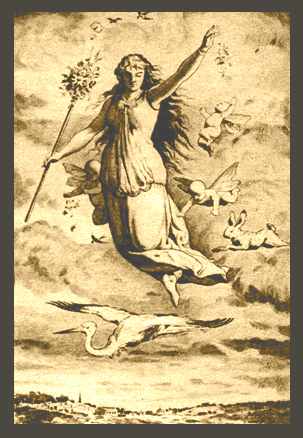 |
Eastre and the original flying Easter bunny. |
Since Eastre was the goddess of fertility there was an extremely fertile animal associated with her, the highly reproductive critter was---drum roll please……..a rabbit. Her name was Oschter Haws. Holy Hasenpfeffer Batman!!!! Is that where we get the Easter bunny? Yup. Like the Yule log, the Christmas tree and holly, this pagan custom crept into Christianity when the Germans converted. The story goes that an injured bird was brought to Eostre; she was unable to fully restore it so she transformed it into a hare. The hare retained its ability to lay eggs and did so every spring in honor of the Goddess and the Earth's rebirth. Thus, the tradition of a bunny bringing eggs to children.
It's interesting (and weird) to note that an old expression for asking a woman if she was pregnant was: Did the rabbit die? An archaic pregnancy test consisted of injecting a woman's urine into a live rabbit. If it died you could expect a blessed event. In reality, the rabbit always died, however, if the woman were indeed pregnant the rabbit's ovaries would bulge. This, of course, was determined post-mortem. Obviously Bugs Bunny heaved a sigh of relief when they invented E.P.T.
The Easter Bunny
When German immigrants came to America and unpacked their folklore baggage, the Easter bunny hopped out. It was widely ignored by other American Christians until shortly after the Civil War.  German-American children believed that if they were good the "Oschter Haws" would lay a nest of colored eggs. The children would build their nest in a secluded place in the home, the barn or the garden. Boys would use their caps and girls their bonnets to make the nests. The use of elaborate Easter baskets was a later addition to the tradition.
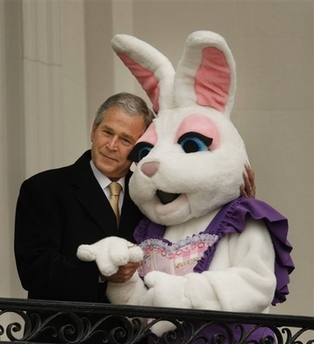 German-American children believed that if they were good the "Oschter Haws" would lay a nest of colored eggs. The children would build their nest in a secluded place in the home, the barn or the garden. Boys would use their caps and girls their bonnets to make the nests. The use of elaborate Easter baskets was a later addition to the tradition.
Further Looniness about Bunnies. (Not Bugs.)
Since ancient times rabbits have been considered symbols of fertility, sexuality and even immortality buried along with royals. Note the famous paintings of the Virgin Mary holding a pure white bunny to denote her virginity.

If you want to go down the rabbit hole about rabbits here's a great article written by a folklorist
https://theconversation.com/sacred-hares-banished-winter-witches-and-pagan-worship-the-roots-of-easter-bunny-traditions-are-ancient-180484
Easter Tuesday?????
Prior to A.D. 325, Easter was variously celebrated on different days of the week, including Friday, Saturday, and Sunday. (Was Good Friday called Good Wednesday when Easter fell on a Friday?) In 325 the Council of Nicaea was convened by the Roman Emperor Constantine. It issued the Easter Rule, which states that Easter shall be celebrated on the first Sunday that occurs after the first full moon on or after the vernal equinox, or first day of spring. Is that why Easter Sunday is always hopping around? Uh-huh. The Greek Orthodox Church and the Roman Catholic Church officially split in 1054 AD. The Greeks continued to determine the date of Easter using the Julian calendar even after The Romans Catholics switched to the Gregorian calendar. Thus their different dates for the same Holy Day. (The split between the two churches became irreparable in 1204 AD when Venetian bankers arranged with the Vatican to have an army of Crusaders sack Constantinople (Venice's business rival) on the way to the Holy Land. The Crusaders sacked the Holy Christian City of Constantinople (Istanbul) and that was that.

Easter Eggs
The egg of course is universally understood as a symbol of life.
In Pagan times the egg represented the rebirth of the earth. Winter was over; the flowers burst forth from the earth just as the chick burst out of its shell. (Is that why folks put Easter decorations up with pictures of chicks popping out of eggs?) With the advent of Christianity the symbolism of the egg changed to represent, not nature's rebirth, but the rebirth of man. Christians embraced the egg symbol and compared it to the tomb from which Christ rose.
There are many Eastern European legends about coloring eggs. One legend concerns the Virgin Mary holding a basket of eggs while crying at the foot of the Cross. Her tears fell upon the eggs leaving them with splashes of brilliant color.
During the Middle Ages the Brits were big on decorating and coloring eggs. In 1290, Edward I had four hundred and fifty eggs gold-leafed and colored which he presented as Easter gifts.
The world’s most famous Easter eggs were those made by the well-known goldsmith, Peter Carl Faberge. In 1883 Czar Alexander commissioned Faberge to make a special Easter gift for his wife, Empress Marie. You, dear Gothamites, were once in a most envious position. The largest collection of Faberge eggs outside of Russia used to reside at The Forbes Museum at 62 Fifth Ave. But did you ever get off your keester and go over there when they were there? Unfortunately, they’ve been sold and now Forbes is fresh out of eggs.
Easter Parades

Historically in New York, Fifth Avenue is where each religious franchise plopped its flagship building i.e. St. Patrick's Cathedral, Temple Beth Israel. At Fifth Avenue and 52nd street (next to the Museum of Modern Art) you'll find St. Thomas Episcopal Church. It had a very, very well to do congregation. The opulent spring wardrobe worn by the women parishioners as they exited the church onto Fifth Avenue became known as the Easter Parade.
It has transformed into a somewhat pedestrian mall cum parade, kind of a weird Venice beach meets Fifth Avenue stroll.
So class to summarize:
We've taken an ancient agrarian festival celebrating the rebirth of the earth, reinterpreted it as a religious festival celebrating the resurrection of Christ and then turned that into a festival where a bunny rabbit sneaks into a house and leaves stuffed rabbits, chocolate lambs, colored eggs and chocolate scale models of ancient execution devices (crucifixes) for children. Unlike Santa, the rabbit doesn't check once, nor twice if you've been nice. He just gives you the goodies and hops back down the bunny trail.
And you wonder why kids today are so confused.
That's about all the trivia I've got. Now I must return to my research trying to uncover the Pre-Columbian origins of the marshmallow chick.
Happy Noruz, Eostre-Passover, oh and welcome home Persephone.
Dano


